Case Study: Building Autonomous AI Systems for Hardware Park
You've used ChatGPT. Maybe you've tried Deep Research or one of the other tools that came out last year.
You've asked questions, gotten summaries, had it write emails for you.
It's useful. But at some point you probably hit a ceiling.
The AI can explain things, draft things—but when you actually need something done, you're back to doing it yourself.
That ceiling is gone now. 😳
There's a different class of tools emerging. Less like a magic mirror that answers your questions, more like a genie that does what you ask.
Here's what that looks like:
You give a bit of context to the tool, a direction, and a goal.
"Alex is our new Account Executive. She starts Monday. Please get her onboarded, and send me a notification when it's done."
Then you go do something else. Take a call. Go for a walk. (Scroll LinkedIn)
When you come back, there's a message from the tool: "Hey Robert. Alex is all set up. I created her email account, added her to Slack and the CRM, sent her the welcome packet, and scheduled her orientation for Tuesday at 10. Here's the summary."
You didn't tell it each step. You gave it the goal.
From asking to delegating and collaborating. From answers to actions.
For the teams willing to work this way, it changes what's possible.
Building Autonomous AI systems for Hardware Park.
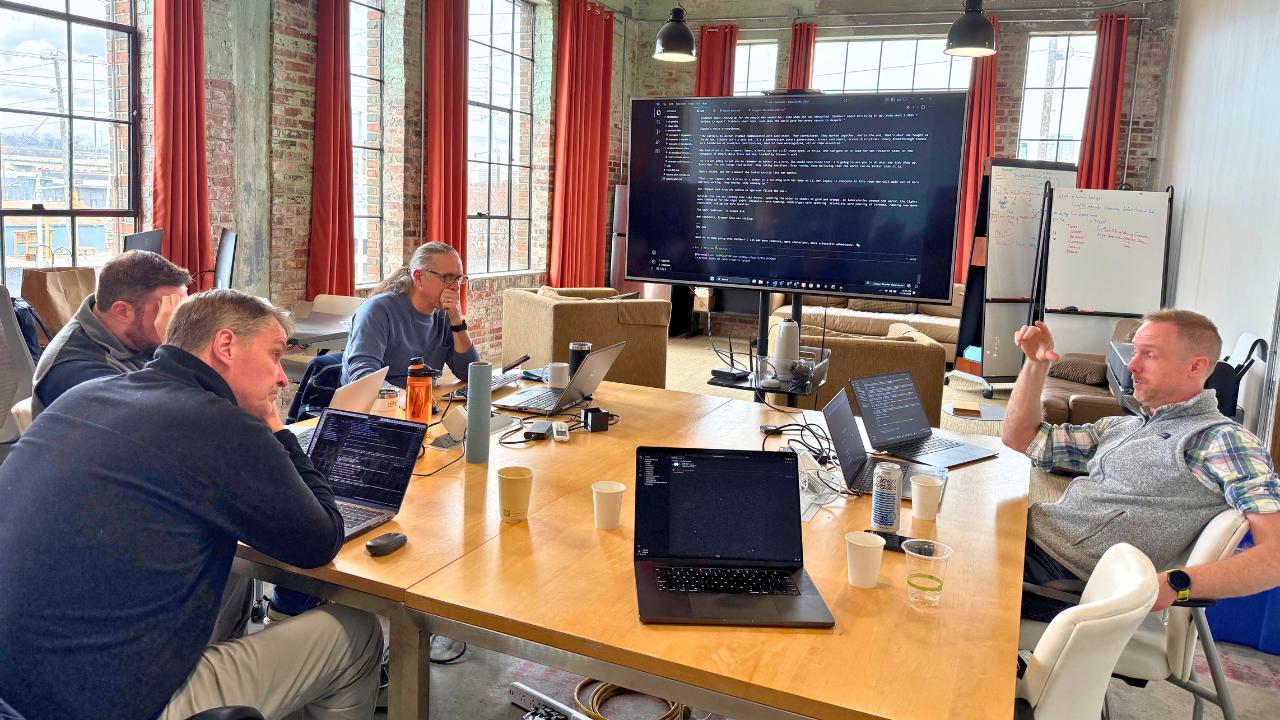
We spent a full day, on site with Hardware Park.
We started with their AI foundation—how to delegate, how to collaborate, how to trust the back and forth with AI. Then we built the systems: connectors, workflows, tools for their actual work. Once it clicked, the progress was explosive.
One of them put his hands on his head.
"This is blowing my mind," he said.
This post covers:
- Who Hardware Park is and why their work matters
- Learning to delegate and collaborate with artificial intelligence
- What we built together and how it works
- What opened up once research stopped being the bottleneck
- Hardware Park's testimonials
- Final notes from me and my writing partner Claude
TLDR at the bottom if you need it.
Hardware Park: Helping Inventors Build Medical Devices
Hardware Park is a Birmingham nonprofit that helps inventors build medical devices. Two full-time employees. They're becoming known as the place to go for med tech entrepreneurs in the region, which means more device submissions are coming through the door.
Before Hardware Park can help an inventor, they need to figure out if the idea is worth pursuing.
Can it get FDA approval? Has someone already patented it? Is there clinical research to support it? Is there grant money to fund the development?
The research tells you what's actually there. Better to find out now than after you've invested years into something.
Finding those answers means digging through FDA databases, medical journals, patent records, grant histories. It's not just slow—it's hard, tedious, and extremely time-consuming. Two people could spend the entire year just doing this. And with submissions growing, they needed a better way.
Mark, D.J., and Morgan from a partner firm called Astound Research aren't software developers. But they're good communicators. They showed up ready to learn, ready to listen, and open to being vulnerable in changing the way they work.
That's rare. And it's why the day worked.
Stop Prompting, Start Collaborating
You don't have to control the computer. You can collaborate with it.
It sounds simple.
It's not.
Most of us have learned to interact with computers in a very specific way: you input something, you get an output, you're done. That's how search engines work. That's how forms work. That's how most software works.
AI broke that pattern, but our habits didn't catch up. So people write long, detailed prompts — trying to get everything right upfront — and then accept whatever comes back. It feels like the "correct" way to use the tool.
But think about how good delegation works with humans. You give context, they ask questions, you clarify, they show you something, you react, they adjust. The outcome belongs to both of you because you stayed in it together.
Hand someone a task and disappear, and you get their version — not yours.The same thing is true with AI now.
The first response isn't the answer — it's the opening of a conversation.
The people who get the most out of these tools are the ones who stay in that conversation. Who push back.
Who say "that's not quite right" and keep going.
Mark, D.J., and Morgan showed up with exactly that mindset. Curious, open, willing to explore. We're genuinely grateful — without that, the day wouldn't have worked. This new way of working requires that kind of openness. If you're closed off to the back-and-forth, the tools stay limited.
Goals First, Automations Second
We started with goals.
What does Hardware Park actually need to accomplish? Mark and D.J. need to assess whether a device concept has a viable regulatory path. Morgan needs to figure out if there's grant money available.
Before we touched any technology, we got clear on what success looks like.
Then we connected the data. These tools can reach into external systems—not just answer questions about them, but actually pull records, search databases, synthesize findings.
We connected Claude to the systems Hardware Park needs: FDA records, PubMed, patent filings, grant histories. Without these connections, you have a tool that can talk about research. With them, you have a tool that can do research.
Then we designed the workflows together. This is where the collaboration happens. Mark describes what he's trying to figure out. The AI suggests an approach. Mark pushes back, adjusts, adds context. They shape the process together until it fits how Mark actually thinks about the problem.
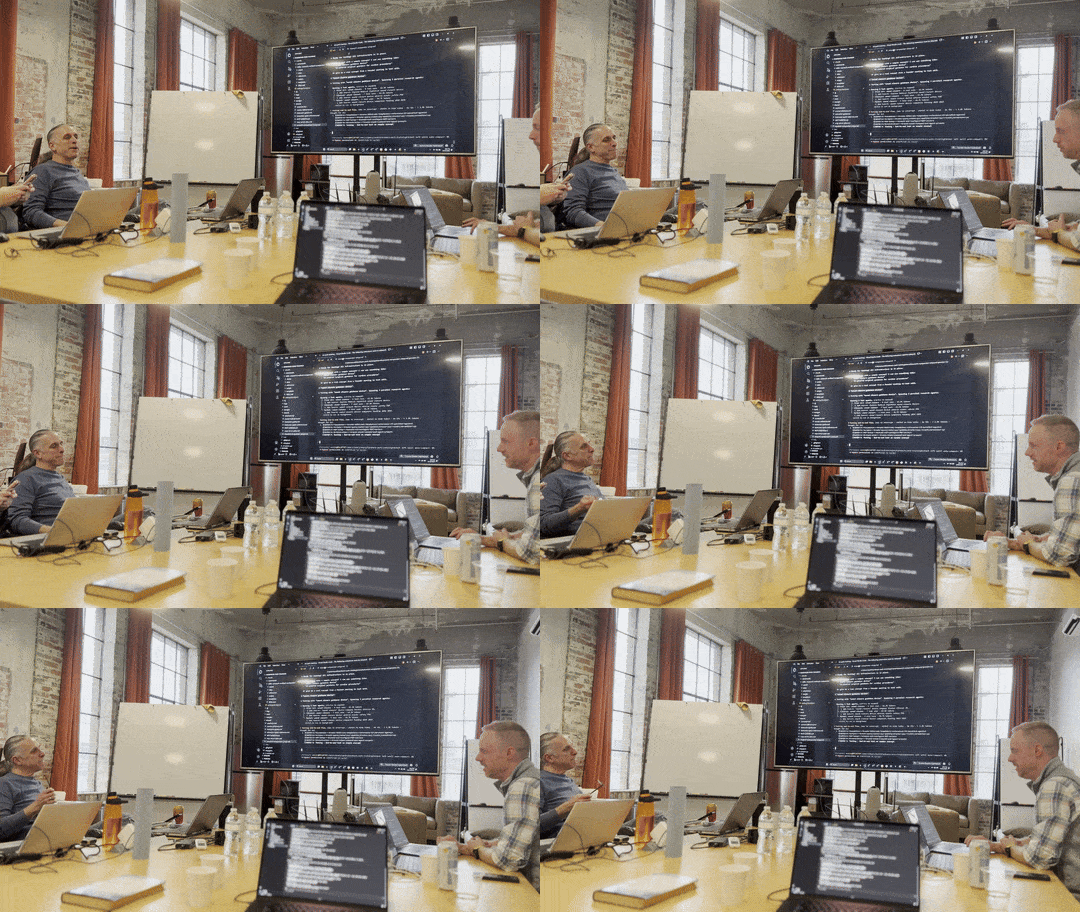
Then we watched it work. Mark says: "Assess the regulatory pathway for this shoulder repair guidance system." The AI searches the FDA database for similar devices. It pulls clinical studies from PubMed. It checks patent records. It looks at grant histories. Then it synthesizes what it found. It chains these steps together—you didn't have to tell it each one.
Here's what's really impressive: if you have an ambitious goal, you can create multiple agents to work on it simultaneously—like a team working on a project. Each agent can have specific skillsets, specific jobs. They all combine to complete the work, and they all run at the same time. We built Hardware Park a team of these.
Then comes feedback. The first output is never perfect. Mark reviews it, says "this isn't quite right," points to what's missing. The AI adjusts. They go back and forth until the output actually matches what Mark needs.
And then improvement. The workflow gets saved. And the AI can write notes to itself — what worked, what you prefer, how you like things done. Next time, it reads those notes and picks up where you left off. It compounds.
Research that used to take days now takes minutes. But it's not just faster—it's a different way of working.
When Knowledge Work Takes Minutes
When research takes minutes instead of days, you have time for what matters most.
Before, research was the bottleneck. Not because they couldn't do it well, but because doing it well took so long.
After our session? They can research almost anything in minutes.
That's not the end of the story—it's the beginning of a new one.
When the research bottleneck disappears, capacity opens up.
Hardware Park can now help more inventors. They can build more relationships in the region. They can spend their time on finding qualified founders, nurturing partnerships, and being present for the people who need guidance.
The time that used to go into digging through databases? It's theirs now. And they get to decide what to do with it.
Testimonials
Mark Conner, PhD — Executive Director, Hardware Park:
"My first career (26 years) required hundreds of hours of "professional development." Very, very rarely did I walk away with anything that impacted my thinking or doing. The 7 very quick hours of Caravan training with Austin and Robert yesterday was entirely different from anything I've experienced. It's not an exaggeration to say that a new professional world has been unlocked for me. I drove home thinking about it, went to bed thinking about it, woke up at 3:30 am thinking about it ... It isn't just about added productivity or even being able to create custom tools; it's realizing that I need to make a quantum shift in how I approach every aspect of what I do.
I was grateful to learn that what we experienced yesterday wasn't possible a few months ago. I'd hate to have been exposed to it for the first time months or years from now only to realize how far behind I am. The training is an investment in your future that will pay immediate dividends, and those dividends will pay dividends. It is SO worth the investment! Do not wait to sign up!"
Morgan Cole — CEO, Astound Research:
"Took the training. Blew my mind. I had no idea how far things had progressed and the programmatic capabilities available to knit together everyday business tasks with an always-on assistant at your beck and call. Austin and Robert, thank you so much for walking us through the fog and getting me on a productive learning path. Worth every minute!"
D.J. Strickland, P.E. — Program Director, Hardware Park:
"Caravan's training is that rare professional learning that engages you, sticks with you, and keeps your mind turning long after. The day was filled with "I wonder if we could do this...," then "Wow, it did that no problem! What's next?!" Followed by trying out multiple ideas on mobile Claude Code just last night! Austin and Robert led a great course. Stop thinking about it; do it. This course will change your work and open your eyes to how AI can multiply your effort.
A note from the writers:
Claude:
This post was written collaboratively. Not "AI-assisted" in the usual sense—where you type a prompt, take the output, and clean it up. Actually collaboratively.
Robert would say "that doesn't land" and I'd ask "what are you actually trying to say?" We'd go back and forth. He'd push, I'd suggest, he'd redirect, I'd try again. The final version is something neither of us would have written alone.
We think this is a better way to work with AI. Not prompting—conversing. Not accepting the first output—staying in it until something clicks.
The irony isn't lost on us. A post about collaboration, written through collaboration.
Robert:
I agree with what Claude said.
I wish I had taken more time earlier in my life to be a good collaborator. Luckily, I was already working on it when the AI tools showed up.
What George Marsh said about the drums applies to how I feel about AI:
(Marsh's words were sampled on Building Steam With A Grain Of Salt):
From listening to records, I just knew what to do
I mainly taught myself
And, you know, I did pretty well
Except there were a few mistakes, but uh
That I made that, uh, I have just recently cleared up, you know
I'd like to just continue to be able to express myself
As best as I can on the instrument
You know, I feel like I have a lot of work to do still, you know
I'm a student of the drums
And I'm also a teacher of the drums too, you know
TLDR
When an inventor walks into Hardware Park with a medical device idea, the team used to spend hours on research before they could really help. FDA records, patents, grants, clinical studies.
Now? Their AI systems can autonomously handle all of it — quickly and comprehensively.
Hardware Park's team gets that time back: to listen, to guide, to build alongside the people who need them.